Engaging undergraduates in transformative learning.
From fall 2020 - 2025, Student Learning to Advance Truth and Education (IAAR-SLATE) was an initiative designed to engage undergraduates. It created a dynamic, robust, and transformative environment that centered around learning about economic, social, and historic driving forces through evidence-based, interdisciplinary, and community-engaged ways of knowing. Focused on a variety of faculty-driven topics, IAAR-SLATE provided students with novel learning opportunities through three program components: research, coursework, and community-led experiences.SLATE has been a bold,
five-year, pan-university initiative. From its inception, SLATE set out to deepen academic engagement across the university, and it has truly delivered:
• Recruited 74 faculty members for its teaching component
• Reached 4,267 students in over 150 university courses
• Awarded 54 undergraduate research fellowships
• Engaged 26 faculty mentors for summer research
• Connected students and faculty across 10 schools, including Arts & Sciences, Education, Public Health, Journalism, Business, Nursing, Social Work,
Nutrition, Government, and Medicine.
As a reinvigoration and expansion of the College of Arts and Science’s 2019 “Reckoning” initiative, IAAR-SLATE was a program for undergraduate education. Students involved in IAAR-SLATE activities participated in an array of unique learning experiences, strengthened their grasp of the importance of a society that is just and humane.
We aimed for Carolina students to become critical thinkers and actors and to achieve this we employed a critical and robust pedagogy. Faculty and community experts were vital to student learning in IAAR-SLATE. Through focused class assignments, independent research projects under faculty mentorship, and dialogues led by community leaders, thousands of students gained important insights and gained an appreciation for the significance of scholarly research (including research that informs classroom assignments) and community lived experience as mechanisms for advancing truth.
Anna Agbe Davies
Co-Director
Dr. Agbe Davies led IAAR-SLATE’s Coursework Component. As Faculty Teaching Director, she shaped the vision for students’ experiences in classes affiliated with IAAR-SLATE. Dr. Agbe Davies is also a historical archaeologist with a Ph.D. from the University of Pennsylvania. Her research interest focuses on the African diaspora ranging from the plantation societies of the colonial southeastern US and Caribbean to 19th and 20th-century towns like New Philadelphia and Chicago in Illinois and Durham, North Carolina.
Renée Alexander Craft
Co-Director
SLATE’s Research Component was led by Dr. Renée Alexander Craft, Professor in the Department of Communication and Curriculum in Global Studies. As Director of SLATE-Research, Dr. Alexander Craft created the vision for and organization of undergraduate research activities that fulfilled the program’s mission. Dr. Alexander Craft’s own research interests concern the relationship among sociohistorical constructions of Blackness, Black cultural performance, and discourses of Black inclusion and exclusion within a hemispheric American framework. She has explored these topics in her work looking at an Afro-Latin community located in the small coastal town of Portobelo, Panama, whose members call themselves and their carnival performance tradition “Congo.”
Annual SLATE Undergraduate Research Symposium
Since its inauguration in 2021, the program convened an annual interdisciplinary SLATE Undergraduate Research Symposium that showcased the original or faculty-led research projects undertaken by our Undergraduate Research Fellows over the program’s 10-week summer experience.
Past Events
2023 Symposium, September 12th-13th
2022 Symposium, September 7th-8th
2021 Symposium, September 8th-9th
Inaugural IAAR-SLATE Keynote Address
Using Project-Based Learning To Recover African American History in Elizabeth City, NC, June 16, 2021
Between 2017 and 2021, students at Elizabeth City State University have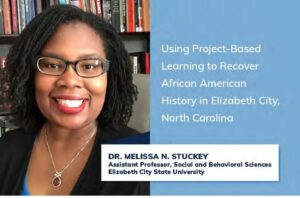 participated in several projects and events related to local African American history in Elizabeth City, N.C. under the direction of Dr. Melissa N. Stuckey. Elizabeth City has been the site of nationally significant events occurring from the era of slavery through the Civil Rights movement. In spite of this, the city and region rarely get more than passing mention in scholarship about African American history. Dr. Stuckey will highlight her use of project-based learning and public engagement that has resulted in building up the archive of source material available for the study and public awareness of African American history in Elizabeth City.
Coursework Component
IAAR-SLATE’s Coursework Component built a network of courses to engage the program’s topics through student classroom experiences. For 2020-2021, more than 25 faculty connected their courses to IAAR-SLATE by agreeing to include on their syllabi three shared, intersecting assignments across all IAAR-SLATE courses. They were a way to connect students across diverse classes, expanding the dialogue beyond a single classroom. Additionally, through a variety of convenings and activities, students in IAAR-SLATE courses had an opportunity to meet authors, filmmakers, and other special guests directly related to the material assigned in their classes.
Spring 2025 SLATE Teaching Fellows:
Allison De Marco, Social Work
Suzanne Lye, Classics
Michal Osterweil, Global Studies
Molly DeMarco, Nutrition
Nina Martin, Geography
Rosa Li, Psychology and Neuroscience
Research Components
All IAAR-SLATE components were informed and shaped by research, but our Research Component allowed a selected cohort of students to pursue original, independent, scholarly research on a topic of their choosing during the summer. Students’ research was guided by a UNC faculty member, whose own research IAAR-SLATE also supported during the summer. In the Fall, students presented their research at an undergraduate research symposium open to the entire campus and broader community.